Monday, June 4, 2012

Zone 3 - Forest Tent Caterpillars dine on haskap leaves

Every ten years or so the forest tent catepillars arrive en masse and this year there is a new item on the menu - haskap leaves!

Forest tent caterpillar munching on haskap leaf
Folded leaf makes cozy home for tent caterpillar larvae.
Morning dew still on leaves.
Pried open haskap leaf reveals forest tent caterpillar larvae in cocoon
So far there are a couple of caterpillars per plant on one end of the orchard. Most of the growth has occurred already (12-24") and the berries are starting to turn purple.

Borealis haskap berries turning purple
They seem to turn purple overnight, and yes, you will just have to taste one before it's ready, but the sourness will definitely encourage you to wait another 3 weeks for the rest to ripen to a more palatable taste!

Tundra haskap
Potted haskap will ripen a good week or two prior to the ones planted in the ground. These Tundra berries look like they are ready to eat, but still need a couple more weeks to turn sweet.

Borealis and Tundra blossom over the span of a week or two, so we probably want to wait a good month from the time the first berries turn dark blue until harvest. However, Chris in CT reports, "My kids ate the berries before they fully ripened. They liked their tartness."

Friday, April 27, 2012

Zone 7 - Georgia - Tundra Haskap Berries

I bought 2 Borealis and 2 Tundra haskap/honeyberryplants in the spring of 2011. I planted them at my cabin in the north Georgia mountains. We had a long and *very* dry summer (1 inch of rain over three months), and I was surprised actually to have only lost one of my four honeyberries (one of the Borealis). The other plants are actually thriving in part sun it seems. Considering how hot and dry the summer was here, that's pretty good for a plant that is supposed to live in the frigid north!

Berries from 2 year old Tundra

Berries on 2 year old Tundra

Two year old Tundra growing in part sun, north Georgia mountains
Anyway, this email was just to send you pictures of my first harvest (from the Tundra plants). Not a lot yet, and I'm pretty sure these weren't even pollinated (my pollinator plants are still too small). But let me tell you they sure were delicious :)  Kevin, Georgia


Saturday, April 21, 2012

Zone 5b - Maine - Borealis and Tundra Haskap Blossoms


2 year old Borealis

2 year old Tundra
They did well their first year with most more than doubling in size, and by the beginning of winter I was super psyched for this spring and the possible berries it would bring. Well they didn't disappoint as the plants have not just already doubled in size again (in just 3-4 weeks) but they are loaded with little berries with plenty more flowers out and forming. Brian, coastal Maine

Sunday, October 2, 2011

Fall Haskap Blossoms


Lonicera Caerulia L. have not ceased to surprise me. Our biggest plant, a 3-year-old potted Tundra was accidentally left out in the hot sun for a several days in late August and completely dried out. Most of the leaves shriveled up and fell off. Having seen tremendous tenacity in other blue honeysuckles that had come upon hard times, I doused it with water and kept up with the moisture for the next month. But not seeing any new growth, I thought I would have to wait until spring to determine if it survived. Can you imagine my shock to find this gorgeous cluster of blossoms at the end of one of those "dead branches"?

Fall blossoms on 3 year old Tundra, Sept. 27, 2011
Then the question was whether these blossoms would turn into berries. While another blue honeysuckle plant of a different variety is recommended for maximum fruit production, it is possible to get fruit without another plant. And sure enough, this Tundra did not disappoint us. Out of the half dozen or so blossoms, we found three little green berries! Another twenty days or so and they should be ripe!  - Nov. 15 update: no berries matured :-( Guess I'll have to wait 'til spring!
Three berries have formed, Oct. 2, 2011

I have also seen haskap survive after being stripped of all its leaves through accidental weeding. Haskap may need at least a month or more to show any sign of life, so don't give up on them too soon! Only 1.3% of this spring's shipment did not survive transplanting for unknown reasons, and once they get established they are very hardy.    -Bernis, northern MN


Monday, August 15, 2011

Zone 3 - MN - Tundra haskap berry surprise


While down on my knees hand weeding the haskap plants in our orchard I was shocked to find blue treasure! Yes, there at the end of the older wood (but still first year growth) was a Lonicera Caerulia berry! I found six of these precious gems on six bushes, or on 2% of the Tundra plants. No berries were found on any Borealis or Berry Smart Blue plants. No berries were found on the year old plants (2nd year growth) that had produced blossoms earlier in the season. So what was it that made those select 2% Tundra plants so special?
Foot tall, first year Tundra plant with berry
These bushes were propagated by tissue culture in the winter of 2011, nurtured in the greenhouse in Canada until mid June, shipped to Minnesota and planted at the end of June. Six weeks later these berries were discovered. Even though the berries look ripe on the outside, the one berry I sampled was quite tart, indicating it lacked a few weeks yet to fully ripen inside. 
Tundra Berry on first year plant
"Starting with day zero when the flower is fertilized, cell division occurs during days 0 – 23. High respiration occurs during this phase, i.e. plant uses lots of energy to build cells. This may be the most crucial phase for watering haskap. Cell expansion occurs during days 24 – 42, when the cells get filled with water. The berry is green and very firm until day 23. Almost overnight it turns blue on the outside, but needs about three more weeks for the inside to turn dark blue indicating it is fully ripe." (James Dawson, grad student, U of S)
Tundra berry 11/16" long from first year plant
What I've seen of Tundra and Borealis is that they can be expected to grow about a foot a year, up to their adult height of approximately 4 feet. I have seen their growth stunted in highly alkaline soil (>7) and heard that highly acidic soil (<5) is not ideal either. Our foot of topsoil has plenty of organic matter with ph 6.5 and heavy clay underneath. The plants have done very well so far with plentiful rainfall this year.   Bernis, northern MN

Zone 5a, Illinois - Borealis Haskap Survivor, planting tips


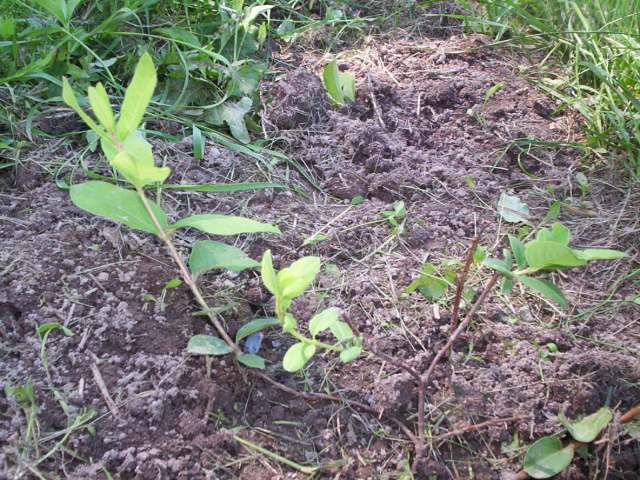
"The leaves on the plants developed brown spots and 7 out of 8 have died. This plant survived after spraying it with an anti fungal spray. I could have done a better job gradually exposing the plants to full sunlight. I planted the berries in Miracle Grow potting soil assuming that they would do well in that kind of soil." Doug, IL (late June planting)
(Editor's notes)
Ideal planting time: late fall or early spring, with dormant plants that can go directly into your pots or ground soil, but we have had very good success with later plantings as well (<2% fatality rate for late June planting). When actively growing plants are shipped, they need adequate hardening off, gradually increasing their exposure to direct sunshine over a 5 day period if the sun is strong.

Brown spots on leaves: The leaves may develop some brown spots during shipping. Our state inspector recommended treatment with a copper fungicide available at local hardware stores, but said it wasn't anything to be overly concerned about. Our experience has shown that the overwhelming majority of plants will survive and produce new growth. Also, in windy areas, the undersides of the leaves may be exposed to the sun scorch (brown streaks) but the leaf does not wither and the plant still survives.

Fertlization: The plants have been given good nutrients in the nursery and do not require additional fertilization the first year, though testing needs to be done to determine what fertilization schedule would be optimal. Aged manure is the tried and trusted fertilizer of choice but we are also looking into other ecologically-based options such as the water soluable 2 step program offered by EarthSoils.  Dry fertilizator spread on top of the soil has burned the bark and killed other growers' plants. Applying water soluable fertilizer in excessive amounts will damage the plants as well. Do not apply fertilizer past mid summer so that the plants do not continue to put out new growth, as they need to prepare their roots for dormancy. 

Thank you, Doug, for sharing your experience and fotos. We not only publish success stories but seek to learn from all experiences, so congratulations on being our HoneyberryUSA 2011 Foto Contest Winner! We trust you'll have better success with your replacement plants in the fall!

Bernis, HoneyberryUSA

Zone 8 - Texan Obituary

Regret to inform you that the heat and drought have combined to cook your tender little Minnesota berry plants, and they are no more. Dan'l, north central Texas  P.S. I take the blame for not watering them more diligently, and yet was afraid to put them in with the other berries, the grasshoppers have been a mini-plague this year.