Showing posts with label haskap berries. Show all posts

Friday, August 10, 2012

Haskap Across the USA


Haskap Across the USA (based in part on this blog) was presented on July 20 at the 2012 U of S Haskap Day in Saskatoon, SK. Based on feedback from across the USA, scorching heat is hard (and sometimes deadly) on Borealis and Tundra haskap, but this is not reflected in the USDA plant zones. One grower is in zone 10b due to warm winter temps, but did not have the scorching summer heat that say OK, zone 7b, had last year.

It is possible to get berries without a non-related variety nearby for pollination, but the fruit will not be as plentiful or as large. Josh in KS (zone 5b) reported "The bad news is the Berry Blue never leafed out. The good is that I have 10 small berries on my Borealis."(Both bushes from year-old stock, planted end of March 2012)

Borealis blossoms in Kansas on year-old plant Apr 15, 2012

Borealis berry in Kansas on year-old plant May 15, 2012

Dean from zone 10b in CA reports, "The average summertime high temp where we are in the San Fernando Valley in Los Angeles is in the high 80’s, low 90’s, and dry, and in the winter daytime temps can be in the 50’s and 60’s.

The Berry Blue is doing very well since planting in April 2011. It's gotten much larger and is sprouting new growth. I'm guessing that the plant is about 18-24" tall now. It has not sprouted fruit, but I didn't necessarily expect that it would as I've only had both plants about 1-1/2 year. The Borealis is doing OK, but has barely grown at all and there's no new growth that I can see, possibly due to transplanting from my garden to the raised bed.

Both plants have developed an odd problem. All of the leaves other than the new growth on the Berry Blue is covered in what look like water spots but are the only leaves in the yard to display such markings, and I water under the foliage."

Two year old Borealis in CA, July 4, 2012
Spotting and drying edges on Borealis leaves in CA is not pretty but plant is surviving.
Might want to check the spots for mycelium. July 4, 2012

Monday, August 15, 2011

Zone 3 - MN - Tundra haskap berry surprise


While down on my knees hand weeding the haskap plants in our orchard I was shocked to find blue treasure! Yes, there at the end of the older wood (but still first year growth) was a Lonicera Caerulia berry! I found six of these precious gems on six bushes, or on 2% of the Tundra plants. No berries were found on any Borealis or Berry Smart Blue plants. No berries were found on the year old plants (2nd year growth) that had produced blossoms earlier in the season. So what was it that made those select 2% Tundra plants so special?
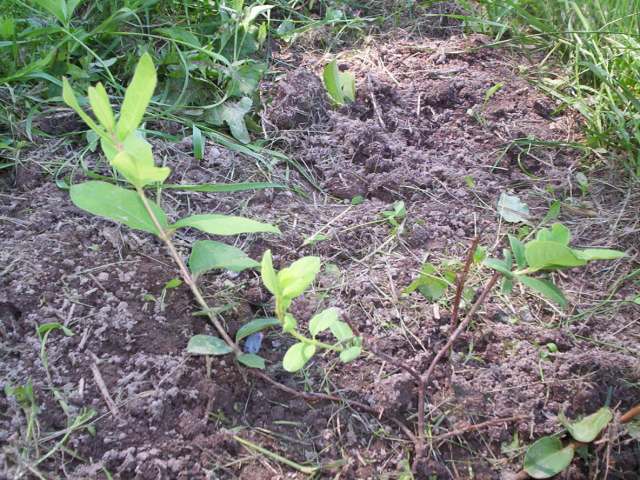
Foot tall, first year Tundra plant with berry
These bushes were propagated by tissue culture in the winter of 2011, nurtured in the greenhouse in Canada until mid June, shipped to Minnesota and planted at the end of June. Six weeks later these berries were discovered. Even though the berries look ripe on the outside, the one berry I sampled was quite tart, indicating it lacked a few weeks yet to fully ripen inside. 
Tundra Berry on first year plant
"Starting with day zero when the flower is fertilized, cell division occurs during days 0 – 23. High respiration occurs during this phase, i.e. plant uses lots of energy to build cells. This may be the most crucial phase for watering haskap. Cell expansion occurs during days 24 – 42, when the cells get filled with water. The berry is green and very firm until day 23. Almost overnight it turns blue on the outside, but needs about three more weeks for the inside to turn dark blue indicating it is fully ripe." (James Dawson, grad student, U of S)
Tundra berry 11/16" long from first year plant
What I've seen of Tundra and Borealis is that they can be expected to grow about a foot a year, up to their adult height of approximately 4 feet. I have seen their growth stunted in highly alkaline soil (>7) and heard that highly acidic soil (<5) is not ideal either. Our foot of topsoil has plenty of organic matter with ph 6.5 and heavy clay underneath. The plants have done very well so far with plentiful rainfall this year.   Bernis, northern MN